Hindu Swayamsevak Sangh - NederlandSanskar · Sewa · Sangathan
By HSS Nederland | 5/11/2026
In every generation, institutions face a fundamental test: can they remain relevant without sacrificing their essence? For the Hindu Swayamsevak Sangh, the Shakha (the weekly gathering at the heart of HSS activity) has passed that test for a century. In the context of the Hindu diaspora in the Netherlands and across Western Europe, this test has never been more urgent or more consequential.
Hindu families in the Netherlands today raise children who are simultaneously at home in multiple worlds: Dutch society, Hindu tradition, global digital culture. The question is not whether their children can navigate these worlds. They do so every day. The deeper question is whether they navigate them with a stable, grounded sense of who they are, or whether identity becomes a source of confusion, compromise, and quiet loss.
The Shakha, I would argue, is one of the most effective answers to that question available to Hindu communities anywhere in the world. This article sets out why.
The Shakha does not teach culture as a museum piece. It transmits culture as a living practice: embodied, joyful, and communal.
Diaspora communities face what sociologists call an 'identity tax': the cognitive and emotional cost of maintaining a minority identity in a majority culture. For Hindu children in the Netherlands, this manifests in familiar ways. At school, the festivals they celebrate are unknown to their classmates. The values their parents hold (dharma, seva, respect for elders, reverence for nature) rarely appear in their curriculum. Over time, some children absorb the implicit message that their heritage is private, peripheral, perhaps even an obstacle to full belonging.
The consequences are not merely personal. When identity is experienced as a burden rather than a resource, communities fragment. Cultural continuity breaks. The wisdom embedded in traditions, wisdom accumulated over millennia, is lost, not because it was wrong, but because it was never transmitted with confidence and joy.
This is the deficit the Shakha addresses. Not through nostalgia or defensiveness, but through something far more powerful: the lived experience of belonging to a community rooted in shared values.
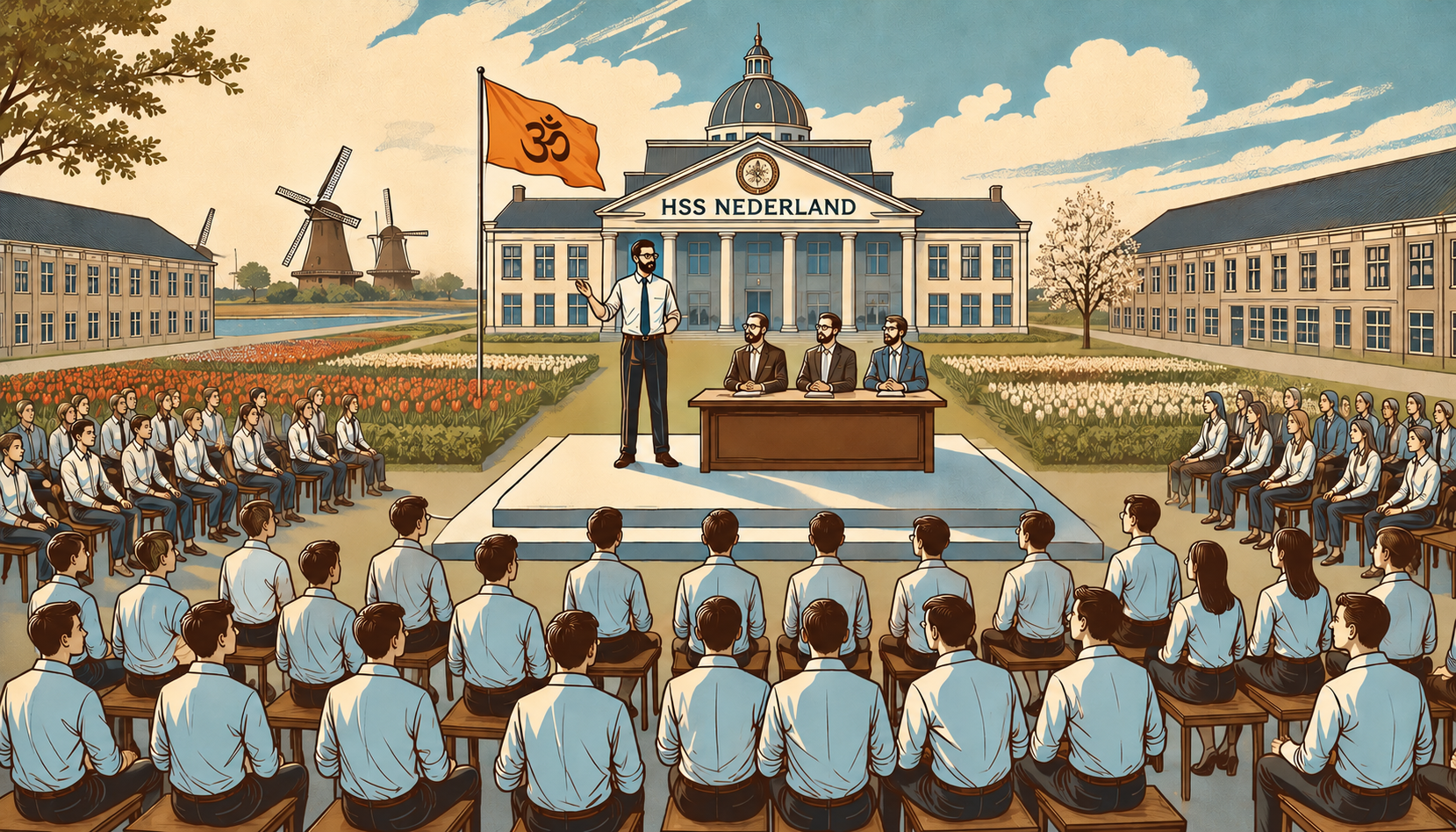
It is worth describing the Shakha concretely, because it is easily misunderstood by those who have not experienced it. A Shakha is not a religious instruction class. It is not a lecture series. It is not a cultural performance. It is, above all, a weekly gathering in which children and youth are invited to grow, physically, intellectually, morally, and spiritually, in the company of peers and mentors who share their heritage.
A typical Shakha session might include:
Surya Namaskar and yogasanas: building physical discipline and bodily awareness
Group games rooted in Bharatiya tradition: cultivating teamwork, strategy, and joyful competition
Geet and bhajans: connecting children to Sanskrit, to music, and to the emotional register of Hindu devotion
Baudhik: guided intellectual discussion on values, history, or dharmic themes
Stories from the Ramayana, Mahabharata, or the lives of saints and heroes: transmitting moral frameworks through narrative
None of these elements is incidental. Together, they constitute a pedagogy that has been refined over a hundred years, one that engages the whole person: body, mind, heart, and spirit. This is what HSS calls the fourfold development of Sharir, Man, Buddhi, and Atma.
The genius of this approach is that it does not separate values from activity. Children do not sit and learn about courage; they experience it when they speak in front of their peers for the first time. They do not read about service; they practice it when they help younger children in the group. Character is not instructed; it is formed through repeated, embodied practice in a safe and affirming community.
Urban sociologists speak of 'third places': spaces beyond home and work (or, for children, home and school) that anchor civic life and social belonging. For Hindu children in the Netherlands, the Shakha functions as precisely this kind of third space. It is neither the private world of the family nor the public world of Dutch institutions. It is a communal space where Hindu identity is neither hidden nor defensive, but simply, naturally present.
This matters enormously. Children who experience their cultural identity as something celebrated and alive, rather than something explained and defended, carry that identity differently. It becomes a source of strength rather than a source of self-consciousness. They can be fully Dutch and fully Hindu, not because they have found a clever compromise, but because they have been formed in a community where both are taken seriously.
For parents, the Shakha offers something equally valuable: a network of families navigating the same questions, a community of trust, and the assurance that the values they hold most dearly are being transmitted not only by them, but by a living tradition larger than any single household.
Character is not instructed; it is formed through repeated, embodied practice in a safe and affirming community.
One of the least visible but most transformative dimensions of the Shakha is its approach to leadership development. In most institutional settings, leadership is positional: you are appointed to a role and given authority. In the Shakha, leadership is relational and emergent. Children take on responsibilities naturally, leading a game, coordinating a session, mentoring younger participants, and through those responsibilities they develop the confidence, judgment, and humility that constitute real leadership.
This is not a trivial distinction. The Hindu community, like any minority community, needs leaders who can navigate complex institutions, represent their community with confidence, and contribute to the broader society without losing their moorings. The Shakha is one of the few environments that cultivates this kind of leadership systematically, over years, through lived experience rather than formal instruction.
I have observed, over many years, the transformation that takes place in a young person who passes through a well-functioning Shakha. The child who arrived shy and uncertain becomes a teenager who speaks with clarity and conviction. The adolescent who struggled to articulate her identity becomes a young adult who embodies it. This transformation is not accidental. It is the fruit of an institution that takes seriously its responsibility to form the whole person.
2025 marked the centenary of the Sangh, a hundred years of the institution whose founding vision was, at its core, a vision of human flourishing through character, community, and service. It is worth pausing to consider what it means that an institution founded in Nagpur in 1925 is today holding Shakhas in Amsterdam, London, Toronto, and Singapore.
The spread of the Shakha model to the diaspora is not mere institutional expansion. It is evidence of the model's essential soundness. The Shakha works, not because it is Hindu, but because it is human. It responds to deep needs that are universal: the need to belong, the need to grow, the need to contribute, the need to be held by something larger than oneself.
The challenge for HSS Nederland, and for HSS communities everywhere, is to ensure that the Shakha continues to be what it has always been at its best: a living, breathing community of formation. Not a museum, not a performance, but a place where real human beings are shaped by real values in real relationships.
The identity questions facing Hindu families in the Netherlands today are not going away. If anything, the pressures of a globalised, digitalised world will intensify them. The Shakha does not resolve these questions, as no single institution can. But it provides something indispensable: a community in which those questions are held with confidence rather than anxiety, and in which the answers are lived rather than merely debated.
For any Hindu family in the Netherlands that has wondered how to give their children both roots and wings, providing the deep security of cultural identity alongside the open confidence of engaged citizenship, the Shakha is, I would argue, not merely one option among many. It is one of the most proven, most human, and most hopeful options available.
The doors of our Shakhas are open. The invitation is always there.
Share Post: