Hindu Swayamsevak Sangh - NederlandSanskar · Sewa · Sangathan
By HSS Nederland | 5/11/2026
There is a word that sits at the very heart of what HSS Nederland does, a word that appears in our motto, in our programs, and in the aspirations we hold for every child and family we serve. That word is Sanskar. And yet, for all its centrality, it is one of the most frequently misunderstood concepts in the Hindu vocabulary, even among those who use it regularly.
Sanskar is typically translated as 'values' or 'cultural refinement.' These translations are not wrong, but they are insufficient. They capture the outcome without conveying the process. They name the destination without describing the journey. In this article, I want to explore what Sanskar actually means: at its philosophical roots, in its practical expression, and in its profound relevance to the challenges of contemporary life.
My argument is straightforward: Sanskar is not merely a Hindu concept. It is a universal framework for human development, one that the contemporary world, for all its sophistication, has largely lost and urgently needs to recover.
Sanskar does not describe what a person knows. It describes what a person has become.
The Sanskrit root of Sanskar is 'samyak-karanam', meaning literally 'that which refines' or 'that which purifies and perfects.' In ancient Indian thought, Sanskar referred to the rites of passage (samskaras) that marked and shaped the transitions of a human life: birth, naming, first learning, marriage, death. These rites were not merely ceremonial. They were understood as acts of formation, moments in which the community gathered to intentionally shape a person's passage from one stage of life to the next.
Over time, Sanskar came to mean something broader: the totality of impressions, habits, and dispositions that are formed in a person through repeated experience, example, and environment. A person with good Sanskar is not someone who knows the right things. It is someone who has been so shaped by their upbringing, their community, and their practice that right action has become natural, second nature as we say in English, though the Hindu concept goes deeper than that phrase implies.
This is a crucial distinction. Sanskar does not describe what a person knows. It describes what a person has become. It is not information; it is formation. And this distinction, between knowing and becoming, is one of the most important and neglected distinctions in contemporary education and culture.
Modern Western culture has, over the past several centuries, made an enormous investment in the transmission of knowledge. Our schools are sophisticated knowledge-transfer institutions. Our universities are among the most impressive engines of intellectual production in human history. We have more access to more information than any civilization before us.
And yet, by many measures, we are in a crisis of character. Rates of anxiety, loneliness, and purposelessness, particularly among young people, are at historic highs in wealthy Western societies. Social trust is declining. Civic life is fragmenting. The basic competencies of a flourishing human life, sustained attention, delayed gratification, committed relationship, appear to be weakening precisely in the societies that have invested most heavily in formal education.
The Hindu tradition offers a diagnosis for this paradox, and it is implicit in the concept of Sanskar: knowledge without formation produces educated confusion rather than wisdom. A person who knows what is right but has not been formed to do what is right is not a fully developed human being. They are, in the Hindu framework, lacking in Sanskar, regardless of their academic credentials or intellectual sophistication.
If Sanskar is formation rather than information, then the question of how it is transmitted becomes paramount. The Hindu tradition is remarkably clear on this question. Sanskar is formed through three interlocking forces: Vaatavaran (environment), Adarsha (example), and Abhyaas (practice).
Environment (Vaatavaran)
We become, in significant part, what our environment consistently presents to us. A child raised in an environment where service is normal will absorb service as normal. A child raised where honesty is consistently practised will find honesty natural. This is why the community environment of the Shakha is not incidental to character development; it is constitutive of it. The environment of the Shakha is intentionally designed to present certain values as normal, natural, and beautiful.
Example (Adarsha)
Human beings are profoundly imitative. We become, in large part, what we see modelled around us. This is why the Hindu tradition places such emphasis on the role of role models, not only the great figures of history and itihasa, but the living example of parents, teachers, and mentors. In the Shakha, Karyakartas and Sevikas are not primarily instructors. They are exemplars, people whose conduct, discipline, and warmth invite children into the kind of life that the tradition commends.
Practice (Abhyaas)
Character is not formed by understanding; it is formed by doing, repeatedly, consistently, over time. The Shakha's structure of weekly physical training, games, storytelling, and discussion is not simply a program. It is a practice regimen for the character. The child who does Surya Namaskar every week is not merely becoming physically disciplined; they are forming habits of body and mind that will serve them throughout their life. The child who helps a younger peer navigate a game is not merely being kind in that moment; they are practising kindness until it becomes natural.
This understanding, that character is formed through practice rather than instruction, is one of the deepest insights of the Hindu tradition, and one that modern developmental psychology is only now beginning to recover.
The goal of Sanskar is not compliance with a code. It is the freedom that comes from having been so thoroughly formed by good values that right action flows without effort.
There is an apparent paradox in the concept of Sanskar that is worth addressing directly, because it is a source of genuine confusion, especially for young people raised in Western cultures that prize individual autonomy above all.
The paradox is this: Sanskar involves being shaped and formed by forces outside the self, namely community, tradition, and practice. Does this not constrain freedom? Is it not a form of cultural conditioning that limits the authentic self-expression that modern culture values so highly?
The Hindu tradition offers a profound response to this question, one rooted in the understanding of the relationship between discipline and freedom. A musician who has practised scales for ten thousand hours is not constrained by that practice; she is liberated by it. The discipline has given her access to a freedom of musical expression that is impossible without it. The same is true of character. A person formed in good Sanskar does not experience ethical action as constraint; they experience it as expression. Right action has become who they are.
The goal of Sanskar is not compliance with a code. It is the freedom that comes from having been so thoroughly formed by good values that right action flows without effort. This is what the Bhagavad Gita calls the state of the sthitaprajna, the one whose intelligence is established, who acts from the deep ground of their being rather than from the turbulence of passing desires and fears.
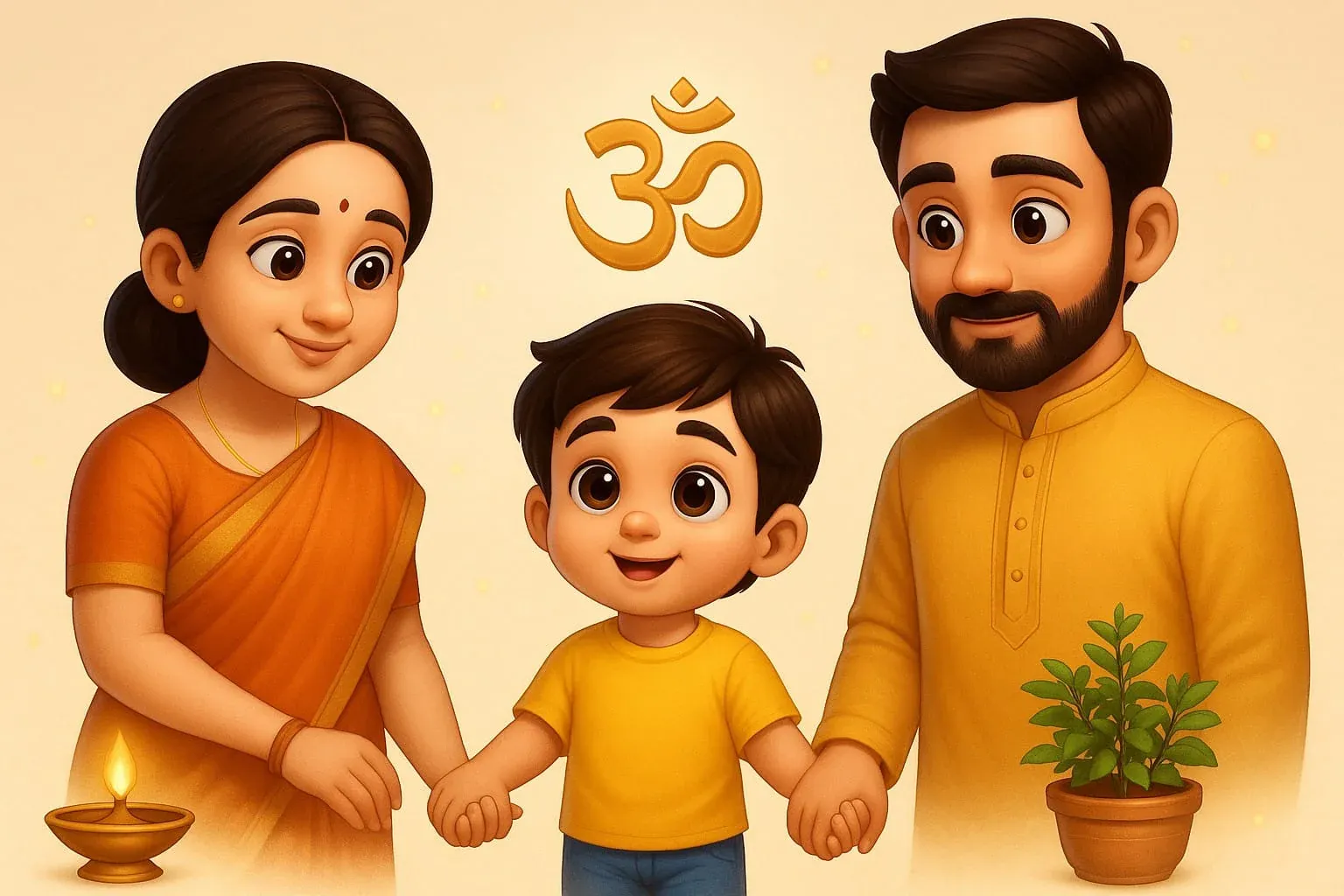
For HSS Nederland, Sanskar is not an abstract philosophical ideal. It is a living, practical commitment expressed through everything we do: the structure of our Shakhas, the character of our Karyakartas, the content of our programs, the relationships we build between families.
Every story told in a Balgokulam session is a small act of Sanskar formation, planting a seed of dharmic imagination in a child's developing character. Every Surya Namaskar practiced together is a formation of discipline and reverence. Every Sewa project in which a family participates is a practice of compassion made habitual. Every festival celebrated with understanding rather than mere performance is a deepening of cultural identity.
The cumulative effect of these practices, over months and years, is what produces a person of Sanskar: someone who
Carries their heritage with confidence and joy, not defensiveness or apology
Acts with integrity not because they have been instructed to, but because integrity has become natural to them
Contributes to their community not from obligation, but from genuine care
Navigates the complexity of modern life, its pressures, its distractions, its moral ambiguities, with a stable sense of who they are and what they stand for
This is the human being that HSS Nederland aims to help form. Not a perfect human being, as that is not a meaningful goal. But a grounded one. A rooted one. One who can flourish precisely because they have been formed by something larger and deeper than themselves.
I want to close with a direct address to the Hindu families of the Netherlands who may be reading this. The formation of your children's character will not happen by accident. In a cultural environment that is largely indifferent, and in some respects actively hostile, to the values you hold, formation requires intention. It requires community. It requires practice.
The forces shaping your children's character every day, through screens, through peer culture, through the implicit values of the institutions they inhabit, are powerful and largely unacknowledged. The question is not whether your children will be formed. They will be. The question is whether they will be formed by intention or by default.
Sanskar, understood properly, is not a relic of the past. It is a sophisticated, proven, and urgently needed framework for intentional human formation. It is what HSS Nederland offers, in practical form, through every Shakha, every Sewa project, every gathering of families committed to raising children who are rooted, strong, compassionate, and free.
The tradition is alive. The invitation is open. The work of formation begins now.
Share Post: